
Random Misfire vs Single Cylinder Misfire: What's the Difference?
Random Misfire vs Single Cylinder Misfire: Spot the Difference. See symptoms, common causes, urgency and practical checks before parts are replaced.
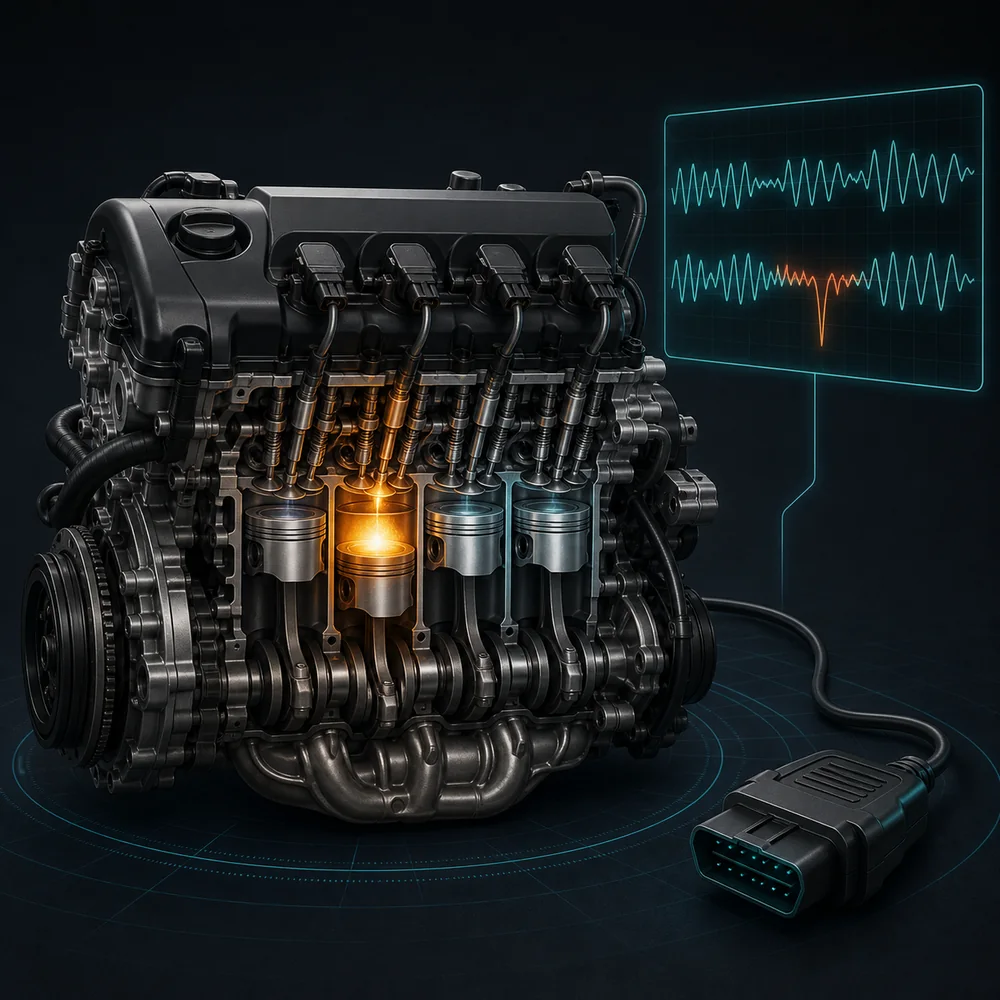
Save all codes and freeze-frame data. The code tells you what the control module detected, not which component must be replaced.
Quick answer
code P0300 indicates a random misfire affecting multiple cylinders, while codes like P0301-P0308 pinpoint a misfire on a specific cylinder. Random misfires are often harder to diagnose because they can stem from system-wide issues, whereas single-cylinder misfires usually point to a problem isolated to one spark plug, coil, or fuel injector.
Random Misfire vs Single Cylinder Misfire: How They Differ Technically
What the ECM Detects
The Engine Control Module (ECM) monitors crankshaft speed variations through the crankshaft position sensor (CKP). A misfire causes a slight drop in RPM on the affected cylinder's power stroke. For random misfires (P0300), the ECM detects these RPM drops across multiple cylinders inconsistently; no single cylinder stands out. This often happens under specific conditions (e.g., cold starts, high load) but not others, suggesting an intermittent or systemic issue like low fuel pressure, a failing mass airflow (MAF) sensor, or exhaust leaks near the O2 sensors.
Single Cylinder Misfire: Isolated and Consistent
With a single-cylinder misfire (e.g., P0301 for cylinder 1), the ECM logs consistent RPM drops only on that cylinder's firing cycle. The pattern is repeatable and tied to one component: a dead spark plug, a faulty ignition coil, a clogged fuel injector, or a broken valve spring. Unlike random misfires, these issues are easier to isolate because the fault is localized. A scan tool's misfire counter will show one cylinder with significantly higher misfire counts than others, even at idle.
Why Random Misfires Are Trickier
Random misfires often point to shared systems: a weak fuel pump starving all cylinders under load, a vacuum leak affecting air-fuel ratios globally, or carbon buildup on intake valves in direct-injection engines. These problems don't favor one cylinder, so the ECM can't isolate the fault to a single component. Diagnosing them requires checking for patterns; misfires only when cold, only at high RPM, or only under acceleration; which narrows the likely causes. For example, misfires during hard acceleration often indicate fuel delivery issues, while idle-only misfires may suggest a vacuum leak.
Diagnostic Approach: Random vs. Single
For single-cylinder misfires, swapping the suspected coil or spark plug with a known-good one from another cylinder is a quick test; if the misfire moves, the component is faulty. For random misfires, technicians start with fuel pressure tests, inspect for vacuum leaks (hissing sounds, hissing with brake cleaner spray near intake areas), and check MAF sensor data for erratic readings. A compression test can rule out mechanical issues, but it's less helpful for random misfires unless multiple cylinders show low compression. An oscilloscope or advanced scan tool with live misfire data is often needed to spot patterns.
Common Overlaps and Misdiagnoses
Sometimes, what appears as a random misfire is actually multiple single-cylinder misfires happening at different times. For example, two failing ignition coils might cause misfires on different cylinders, triggering P0300 instead of individual codes. Conversely, a severe vacuum leak can cause such widespread lean conditions that the ECM logs P0300, even though the root cause is mechanical. Always verify with a thorough inspection; don't assume a P0300 code means the problem is "just" random.
Symptoms You Might Notice
Random misfires often cause a rough idle that smooths out at higher RPMs, or a shudder under acceleration without a consistent pattern. Single-cylinder misfires typically produce a steady miss at all speeds, with a noticeable drop in power and a consistent shake. Both can trigger the check engine light, but single-cylinder misfires may also cause a more pronounced exhaust smell from unburned fuel.
Repair Complexity and Time
Repairs for single-cylinder misfires are usually straightforward; replacing a spark plug, coil, or injector; often taking under an hour for accessible components. Random misfires can require more diagnostic time to trace the root cause, especially if it's intermittent. In most cases, expect to spend more on labor for random misfires due to the investigation involved. See the full P0300 repair cost guide for a detailed breakdown.
Can You Still Drive With Code P0300?
Driving with a random misfire (P0300) is generally riskier than a single-cylinder misfire. Random misfires can lead to catalytic converter damage from unburned fuel, and the inconsistent power delivery can be dangerous in traffic. A single-cylinder misfire is less likely to cause immediate damage but can still reduce fuel economy and performance. In either case, prolonged driving with a misfire can overheat the catalytic converter, leading to costly repairs.
Details that improve the diagnosis
Watch the misfire counters at idle, during a gentle increase in engine speed and under load if a safe road test is possible. Compare fuel trims and note whether the fault follows temperature, moisture or a recent service. A cylinder pattern is often more useful than the code description alone.
Before clearing anything, record whether the code is current, pending, history or permanent. Save companion codes and freeze-frame conditions, then note recent repairs, a weak battery, weather changes and the exact moment the symptom appears. After a confirmed repair, clear only the erasable codes and complete the appropriate drive cycle. A permanent code normally clears only after the onboard monitor verifies that the fault is gone.