
P0350: Ignition Coil Primary/Secondary Circuit Issue
P0350: Ignition Coil Circuit Malfunction Explained. See symptoms, common causes, urgency and practical checks before parts are replaced.
Save all codes and freeze-frame data. The code tells you what the control module detected, not which component must be replaced.
Quick answer
P0350 code means the engine control module (ECM) has detected an electrical fault in the primary or secondary circuit of one or more ignition coils. It typically indicates a short, open, or abnormal resistance in the coil's wiring or the coil itself, preventing proper spark generation. Unlike cylinder-specific misfire codes, P0350 is a general ignition system fault that can affect multiple cylinders.
What the P0350 Code Means: Ignition Coil Primary/Secondary Circuit Malfunction
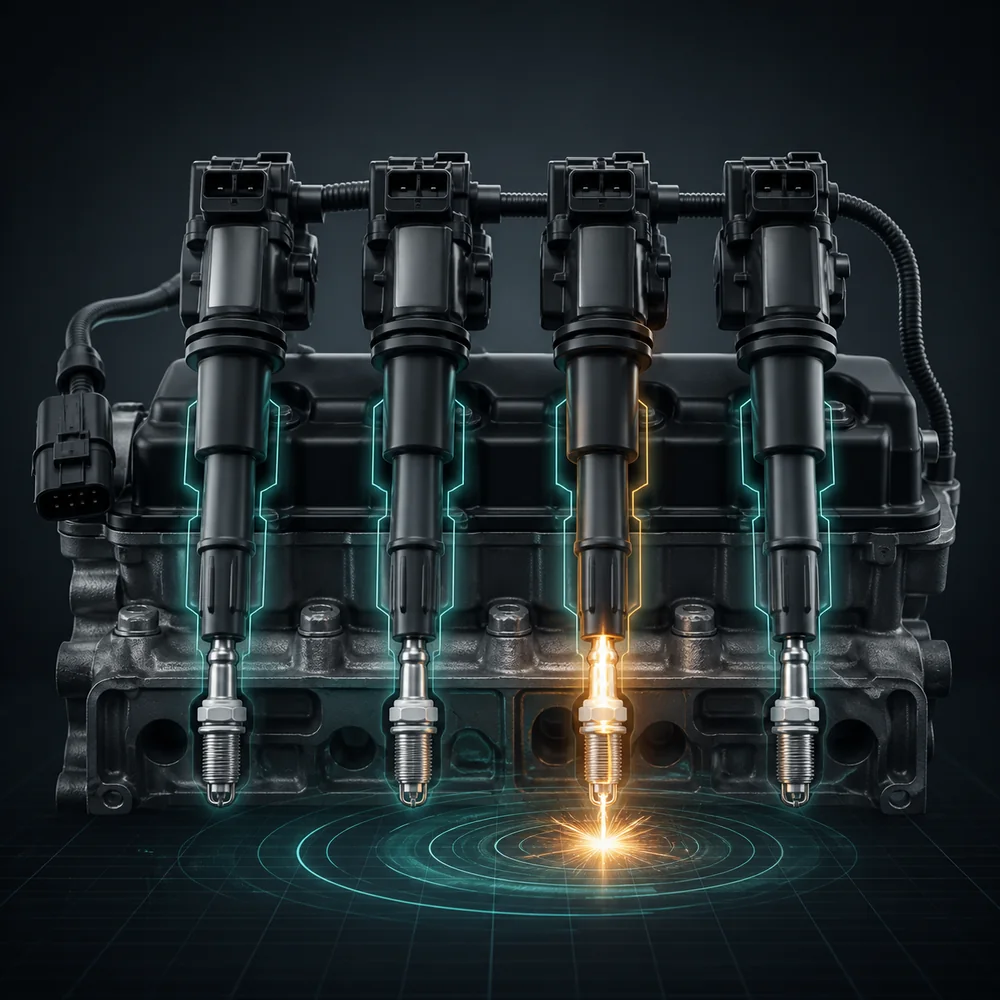
When the ECM triggers a P0350 code, it has identified a malfunction in the ignition coil's electrical circuits. Modern engines use either a coil-on-plug (COP) or a coil pack system, where each coil generates the high-voltage spark needed to ignite the air-fuel mixture. The primary circuit consists of the low-voltage side (12V supply and ground from the ECM), while the secondary circuit is the high-voltage side that delivers the spark to the spark plug. The ECM monitors both for expected voltage, resistance, and signal patterns during operation.
A P0350 code sets when the ECM detects an anomaly such as:
- Open or short in the primary circuit: This could be a broken wire, corroded connector, or a damaged coil internally. If the ECM commands a spark but sees no current flow (open) or excessive current (short), it flags the fault.
- Short in the secondary circuit: High-voltage leakage; often due to a cracked coil tower, damaged spark plug wire (in older systems), or carbon tracking inside the coil; can cause the ECM to sense irregularities in the ignition signal.
- Abnormal resistance in the coil: Ignition coils have specified internal resistance values for both primary and secondary windings. If the ECM's self-test (via voltage feedback or dedicated sensor inputs) detects resistance outside the expected range, it logs P0350.
- Faulty ECM driver circuit: In rare cases, the ECM's internal transistor that controls the coil's grounding (primary circuit) may fail, leading to inconsistent spark delivery.
The code is not cylinder-specific, which is a key distinction. Unlike P0301-P0308 (misfire codes for individual cylinders) or P0351-P0358 (ignition coil circuit faults for a specific coil), P0350 points to a broader issue affecting the ignition system as a whole. This often means the problem is either systemic (e.g., a shared power/ground wire) or that multiple coils are failing simultaneously. In most cases, the ECM will store P0350 alongside cylinder-specific misfire codes if the fault is causing drivability issues.
Diagnosing P0350 requires checking the coil's resistance with a multimeter, inspecting wiring and connectors for damage or corrosion, and verifying the ECM's control signals with a scan tool. A visual inspection of the coils for cracks, carbon tracks, or burnt markings can also reveal secondary-circuit shorts. Because the fault may be intermittent, monitoring live data (such as coil dwell time or misfire counters) while the engine is running can help pinpoint the issue.
Common Symptoms of P0350
Symptoms of P0350 commonly include a rough idle, hesitation during acceleration, and a noticeable lack of power under load. In most cases, the check engine light will flash if the misfire is severe enough to damage the catalytic converter. You may also hear a popping or backfiring noise from the engine bay due to unburnt fuel igniting in the exhaust.
Common Causes and Basic Fixes
Common causes of P0350 include faulty ignition coils, damaged wiring or connectors, or a failing ECM. A visual inspection of the coils and wiring is a good first step, followed by resistance tests with a multimeter. Replacing a defective coil or repairing a broken wire often resolves the issue. For a full list of causes ranked by likelihood, see the full P0350 causes guide.
Can You Still Drive With Code P0350?
Driving with P0350 is not recommended for long distances or at high speeds. The misfires caused by the fault can lead to catalytic converter damage over time, and the vehicle may stall or hesitate unexpectedly, creating a safety hazard. If the check engine light is flashing, stop driving immediately and have the vehicle towed to avoid costly repairs.
Details that improve the diagnosis
Identify whether the code describes a circuit fault or a combustion fault. Confirm power, ground, connector tension and control activity with the correct wiring diagram. A coil swap is useful only when the component and installation are interchangeable and no wiring fault is present.
Before clearing anything, record whether the code is current, pending, history or permanent. Save companion codes and freeze-frame conditions, then note recent repairs, a weak battery, weather changes and the exact moment the symptom appears. After a confirmed repair, clear only the erasable codes and complete the appropriate drive cycle. A permanent code normally clears only after the onboard monitor verifies that the fault is gone.
Related trouble codes
Information to record before any repair
Write down the exact code, its status and every companion code reported by a complete vehicle scan. Save the freeze-frame values, including engine speed, load, coolant temperature, vehicle speed, battery voltage and fuel trims when available. Note whether the warning appeared during a cold start, at idle, under acceleration, after refueling, in wet weather or immediately after other work. These details help separate an intermittent electrical problem from a repeatable mechanical or operating-condition fault.
Identify the exact year, make, model, engine, transmission and market version before using a wiring diagram or specification. Connector pinouts, monitor thresholds, component locations and test procedures can change within the same model line. Check current manufacturer service information and relevant technical service bulletins. A bulletin can improve the test sequence, but it should not be treated as proof that the same fault exists on every vehicle.
How to verify the repair
A warning light that stays off immediately after codes are cleared does not by itself confirm a repair. Recheck live data, repeat the operating condition that originally set the code when it is safe to do so, and confirm that no pending code returns. Some monitors need a specific drive cycle before they run. Permanent codes are normally removed by the control module only after it sees enough successful monitor results. If symptoms remain or the code returns, continue testing instead of replacing another part by guesswork.