
P0316: Misfire Detected on Startup (First 1000 RPM)
P0316 Code: Startup Misfire in First 1000 RPMs. See symptoms, common causes, driving risk and checks that help confirm the fault before parts are replaced.
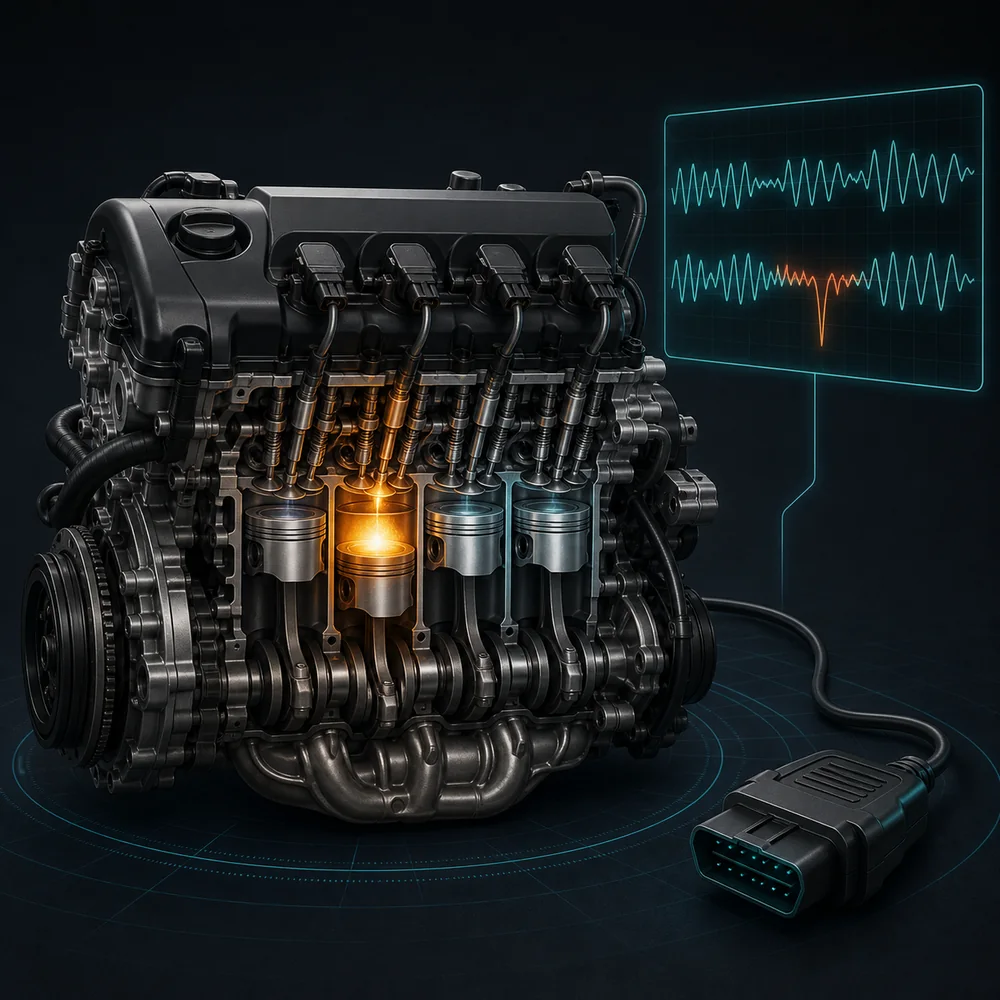
Save all codes and freeze-frame data. The code tells you what the control module detected, not which component must be replaced.
Quick answer
P0316 code means the engine control module (ECM) detected a misfire during the first 1000 revolutions after startup. This early-phase misfire triggers the code specifically because it occurs in the initial seconds of engine operation, often linked to fuel, spark, or air issues that are most pronounced when cold.
How the ECM Detects a Startup Misfire (First 1000 Revolutions)
The P0316 code is a direct result of the ECM's crankshaft position (CKP) sensor monitoring engine revolution irregularities. During the first 1000 revolutions; roughly the first 10-15 seconds of cranking and initial idle; the ECM expects a consistent rotational speed. If it detects an abrupt slowdown or uneven rotation in any cylinder's contribution, it logs P0316, indicating a misfire occurred specifically in this early window.
The CKP sensor provides real-time data on piston position and speed, while the camshaft position (CMP) sensor helps correlate which cylinder is firing. The ECM compares the expected crankshaft acceleration (based on fuel delivery, spark timing, and load) against actual sensor readings. A misfire in the first 1000 revolutions often stems from cold-start enrichments failing to compensate for low fuel volatility, weak spark from aged components, or air leaks that disrupt the initial air-fuel mixture. Unlike continuous misfire codes (e.g., P0300-P0308), P0316 isolates the problem to the startup phase, where conditions like low oil pressure, cold intake air, or sluggish fuel injectors are most likely to cause an imbalance.
In most cases, the misfire is severe enough to cause a noticeable stumble or hesitation as the engine begins to idle. The ECM uses the first 1000 revolutions as a diagnostic window because this is when fuel mixture, spark energy, and mechanical resistance (e.g., cold oil) are at their most unpredictable. If the misfire persists beyond this window, additional codes like P0300 (random misfire) or cylinder-specific codes may also set.
Common triggers for P0316 include faulty spark plugs, a failing ignition coil, clogged fuel injectors, or a vacuum leak that only affects the engine when cold. The ECM prioritizes this code because startup misfires can lead to catalytic converter damage if unburned fuel floods the exhaust system, making early detection critical for emissions and longevity.
What Are the Symptoms of a P0316 Code?
A P0316 code commonly causes a rough or stumbling idle immediately after starting the engine, especially on cold mornings. You may also notice a brief hesitation or lack of power during the first few seconds of acceleration, as the misfire disrupts the engine's initial combustion cycle. In some cases, the check engine light flashes during startup, indicating a severe misfire that could damage the catalytic converter if ignored.
Common Causes of P0316
The most frequent culprits are worn spark plugs, a failing ignition coil, or carbon-fouled fuel injectors that struggle with cold-start fuel delivery. Less common but possible causes include a vacuum leak near the intake manifold or a weak fuel pump that can't maintain pressure during the initial crank. Repairs typically range from $150 to $1,000+ depending on the cause; see the full P0316 repair cost guide for a detailed breakdown.
Can You Still Drive With Code P0316?
Driving with P0316 is generally safe in the short term, but prolonged misfires at startup can damage the catalytic converter over time. If the check engine light is flashing, reduce driving to essential trips only and address the issue promptly to avoid costly exhaust system repairs.
Details that improve the diagnosis
Watch the misfire counters at idle, during a gentle increase in engine speed and under load if a safe road test is possible. Compare fuel trims and note whether the fault follows temperature, moisture or a recent service. A cylinder pattern is often more useful than the code description alone.
Before clearing anything, record whether the code is current, pending, history or permanent. Save companion codes and freeze-frame conditions, then note recent repairs, a weak battery, weather changes and the exact moment the symptom appears. After a confirmed repair, clear only the erasable codes and complete the appropriate drive cycle. A permanent code normally clears only after the onboard monitor verifies that the fault is gone.
Related trouble codes
Information to record before any repair
Write down the exact code, its status and every companion code reported by a complete vehicle scan. Save the freeze-frame values, including engine speed, load, coolant temperature, vehicle speed, battery voltage and fuel trims when available. Note whether the warning appeared during a cold start, at idle, under acceleration, after refueling, in wet weather or immediately after other work. These details help separate an intermittent electrical problem from a repeatable mechanical or operating-condition fault.
Identify the exact year, make, model, engine, transmission and market version before using a wiring diagram or specification. Connector pinouts, monitor thresholds, component locations and test procedures can change within the same model line. Check current manufacturer service information and relevant technical service bulletins. A bulletin can improve the test sequence, but it should not be treated as proof that the same fault exists on every vehicle.
How to verify the repair
A warning light that stays off immediately after codes are cleared does not by itself confirm a repair. Recheck live data, repeat the operating condition that originally set the code when it is safe to do so, and confirm that no pending code returns. Some monitors need a specific drive cycle before they run. Permanent codes are normally removed by the control module only after it sees enough successful monitor results. If symptoms remain or the code returns, continue testing instead of replacing another part by guesswork.