
What Does P0305 Mean: Cylinder 5 Misfire
P0305 Code: Cylinder 5 Misfire Causes & Fixes. See symptoms, common causes, driving risk and checks that help confirm the fault before parts are replaced.
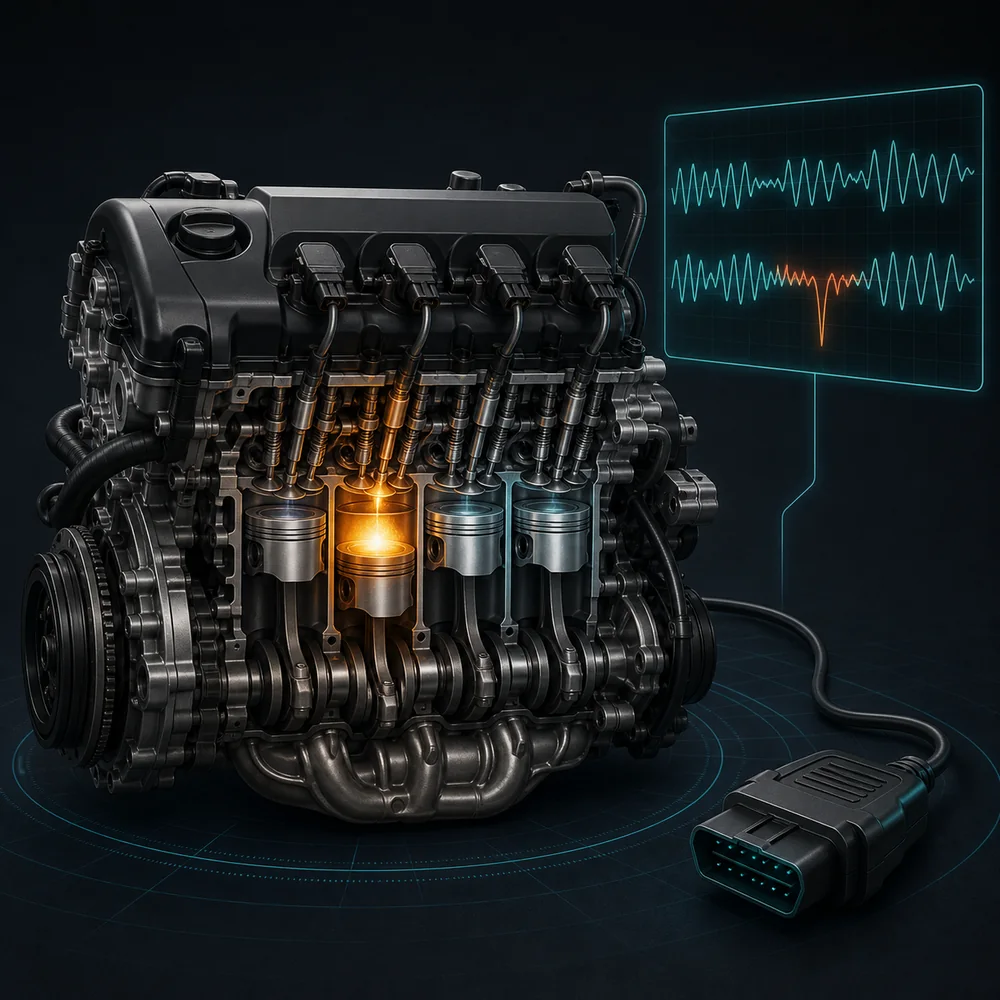
Save all codes and freeze-frame data. The code tells you what the control module detected, not which component must be replaced.
Quick answer
The P0305 code indicates that cylinder 5 in your engine is misfiring, meaning it's not firing properly during the combustion cycle. This triggers the check engine light and is detected by the engine control module (ECM) when it senses a deviation in crankshaft rotation speed specific to that cylinder.
What a Cylinder 5 Misfire Actually Means
A misfire in cylinder 5 means the air-fuel mixture in that cylinder is failing to ignite at the right moment; or at all. The ECM monitors crankshaft position sensor (CKP) data to measure the rotational speed of the engine. When a cylinder misfires, the crankshaft briefly slows down (a "miss") because the power stroke from that cylinder is missing. The ECM compares this irregularity to expected values and, if the deviation exceeds a set threshold, logs the P0305 code specifically for cylinder 5.
The misfire can occur due to an issue in the ignition system (spark plug, coil, or wire), fuel system (injector or fuel delivery), air intake (vacuum leak), or mechanical problems (low compression or valve train issues). In most cases, the misfire is intermittent at first, often worsening under load or at higher RPMs. The ECM doesn't just rely on a single misfire event; it typically requires multiple occurrences within a set number of engine cycles to confirm and store the code.
Cylinder numbering varies by engine layout, but in most inline engines (like a 4-cylinder or 6-cylinder in a line), cylinder 5 is the fifth one from the front. In a V6 or V8, it's usually on the rear bank (opposite the timing belt/chain side), and exact positioning can be found in the vehicle's service manual. This specificity helps technicians isolate the problem to one cylinder rather than guessing across all of them.
The severity of the misfire can range from a slight hiccup to a complete shutdown of that cylinder. A severe or consistent misfire can lead to unburnt fuel entering the exhaust, potentially damaging the catalytic converter over time. The ECM may also enter a "limp mode" to protect the engine, reducing power output until the issue is resolved.
Common Symptoms of a P0305 Misfire
You'll often feel a rough idle or a noticeable vibration, especially at stoplights or when the engine is under light load. During acceleration, the vehicle may hesitate or jerk as cylinder 5 fails to contribute power. In some cases, the misfire becomes more pronounced at higher speeds, leading to a lack of power or poor fuel economy.
Typical Causes and Next Steps
Common causes include a faulty spark plug, a bad ignition coil, or a failing fuel injector for cylinder 5. Less often, it can stem from a vacuum leak near that cylinder or low compression due to a worn valve or piston ring. Repairs typically range from $150 to $1,000+ depending on the cause. See the full P0305 repair cost guide for a detailed breakdown.
Can You Still Drive With Code P0305?
Driving with a P0305 code is generally possible for short distances, but it's not advisable long-term. A persistent misfire can damage the catalytic converter and reduce fuel efficiency. If the misfire is severe or the engine is running rough, pull over safely and have the vehicle towed to avoid further damage.
Details that improve the diagnosis
Watch the misfire counters at idle, during a gentle increase in engine speed and under load if a safe road test is possible. Compare fuel trims and note whether the fault follows temperature, moisture or a recent service. A cylinder pattern is often more useful than the code description alone.
Before clearing anything, record whether the code is current, pending, history or permanent. Save companion codes and freeze-frame conditions, then note recent repairs, a weak battery, weather changes and the exact moment the symptom appears. After a confirmed repair, clear only the erasable codes and complete the appropriate drive cycle. A permanent code normally clears only after the onboard monitor verifies that the fault is gone.
Related trouble codes
Information to record before any repair
Write down the exact code, its status and every companion code reported by a complete vehicle scan. Save the freeze-frame values, including engine speed, load, coolant temperature, vehicle speed, battery voltage and fuel trims when available. Note whether the warning appeared during a cold start, at idle, under acceleration, after refueling, in wet weather or immediately after other work. These details help separate an intermittent electrical problem from a repeatable mechanical or operating-condition fault.
Identify the exact year, make, model, engine, transmission and market version before using a wiring diagram or specification. Connector pinouts, monitor thresholds, component locations and test procedures can change within the same model line. Check current manufacturer service information and relevant technical service bulletins. A bulletin can improve the test sequence, but it should not be treated as proof that the same fault exists on every vehicle.
How to verify the repair
A warning light that stays off immediately after codes are cleared does not by itself confirm a repair. Recheck live data, repeat the operating condition that originally set the code when it is safe to do so, and confirm that no pending code returns. Some monitors need a specific drive cycle before they run. Permanent codes are normally removed by the control module only after it sees enough successful monitor results. If symptoms remain or the code returns, continue testing instead of replacing another part by guesswork.