
P0301: Key Symptoms and Root Causes
P0301 Code: Symptoms, Common Causes & What to Check. See symptoms, common causes, urgency and practical checks before parts are replaced.
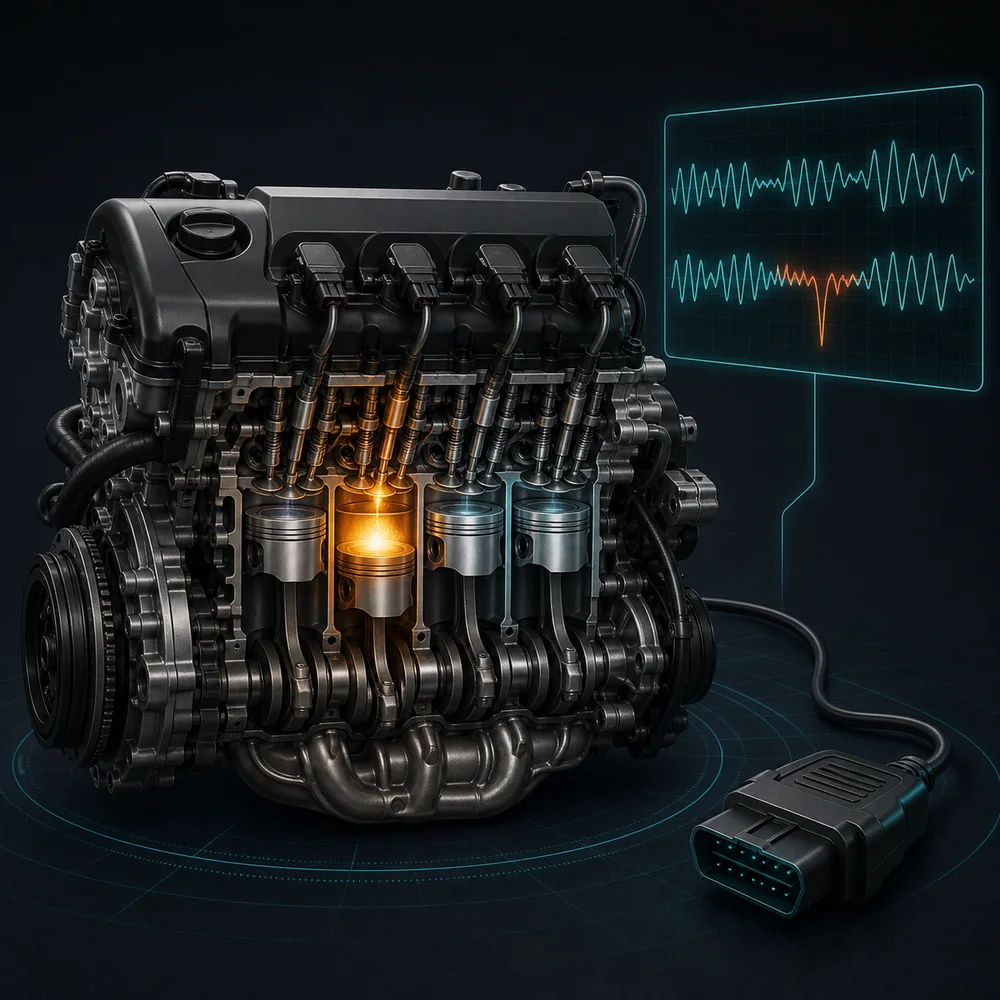
Save all codes and freeze-frame data. The code tells you what the control module detected, not which component must be replaced.
Quick answer
OBD2 code P0301 indicates a misfire detected in cylinder 1. The most common P0301 symptoms are rough idle, hesitation under acceleration, and a noticeable lack of power. Causes range from spark-related issues to fuel or compression problems in that specific cylinder.
P0301 Symptoms and Causes: What to Look For
Symptoms by Driving Situation
At Idle: A rough or unstable idle is often the first sign of P0301. The misfire in cylinder 1 disrupts the engine's balance, causing vibrations or a pronounced "shaking" sensation. This happens because the affected cylinder isn't contributing to power delivery, leading to uneven combustion cycles.
During Acceleration: Hesitation or stumbling when pressing the gas pedal is a classic P0301 symptom. The misfire causes a brief loss of power as cylinder 1 fails to fire properly under load, resulting in a jerking or stuttering feeling. In severe cases, the engine may struggle to rev smoothly, especially at lower RPMs.
At Highway Speeds: Drivers may notice a lack of power or poor throttle response at steady speeds. The misfire can also trigger the check engine light to flash (indicating a severe, catalytic-converter-damaging misfire) or stay solid. Fuel economy often drops because the ECM enrichens the mixture to compensate for the misfire, wasting gasoline.
Cold Start: A misfire that only occurs when the engine is cold may point to issues like a failing spark plug, cracked insulator, or moisture in the ignition system. As the engine warms, these symptoms might temporarily subside if the problem is heat-related (e.g., a temperature-dependent sensor or carbon buildup clearing).
Most Common Causes (Ordered by Likelihood)
1. Faulty or Worn Spark Plug: Spark plugs degrade over time, and the plug in cylinder 1 may be fouled, cracked, or have an improper gap. A bad plug fails to ignite the air-fuel mixture consistently, directly causing misfires. Replacing the plug is often the quickest fix and should be checked first.
2. Damaged Spark Plug Wire or Coil: A broken or worn ignition wire or a failing coil-on-plug (COP) can prevent voltage from reaching the spark plug. In modern engines with individual coils, a bad coil on cylinder 1 is a frequent culprit. Swapping the coil with another cylinder (e.g., cylinder 2) and re-scanning for codes can confirm this.
3. Fuel Delivery Issues: A clogged or failing fuel injector in cylinder 1 can starve the cylinder of fuel, leading to a lean misfire. Low fuel pressure from a weak pump or dirty fuel filter can also cause intermittent misfires across multiple cylinders, but P0301 isolates it to one. A fuel injector cleaning or resistance test can help diagnose this.
4. Low Compression: Internal engine problems like a burnt valve, worn piston rings, or a blown head gasket can reduce compression in cylinder 1. Low compression means the air-fuel mixture can't be properly ignited, even with a good spark and fuel delivery. A compression test or leak-down test is needed to confirm this.
5. Vacuum or Air Leaks: An intake manifold leak near cylinder 1's runner can introduce unmetered air, leaning out the mixture and causing a misfire. Common culprits include cracked vacuum hoses, a faulty intake manifold gasket, or a loose connection. These leaks are often audible as a hissing noise under the hood.
6. ECM or Sensor Issues: Less commonly, a faulty crankshaft or camshaft position sensor can misreport cylinder 1's timing, leading to a misfire. Wiring harness damage or ECM corrosion can also cause false P0301 codes. These require advanced diagnostics, like checking sensor signals with a scan tool.
How P0301 Is Diagnosed
Diagnosing P0301 starts with confirming the misfire using a scan tool to check for pending or history codes. A technician will then inspect the spark plug, wire, and coil for cylinder 1, followed by fuel and compression tests if needed. Swapping parts between cylinders (e.g., moving the coil from cylinder 1 to cylinder 2) can help isolate the issue. For a full step-by-step guide, see the P0301 diagnosis article.
Repair Costs and DIY Potential
Repairs for P0301 typically range from $150 to $1,000+ depending on the cause. Simple fixes like replacing a spark plug or coil may cost $150-$300 at a shop, while more involved repairs (e.g., fuel injector replacement or head gasket work) can exceed $1,000. See the full P0301 repair cost guide for a detailed breakdown. DIYers can often tackle spark plugs or coils with basic tools, saving on labor.
Can You Still Drive With Code P0301?
You can usually drive short distances with P0301, but prolonged driving risks damaging the catalytic converter, especially if the check engine light is flashing. A steady P0301 code may not cause immediate harm, but the misfire can lead to poor performance and reduced fuel efficiency. Avoid heavy loads or towing until the issue is resolved.
Related Codes
P0300 indicates a random or multiple cylinder misfire, often seen alongside P0301 if the issue affects more than one cylinder. P0302 or P0303 may appear if the misfire spreads to adjacent cylinders due to a shared problem like a faulty coil pack or intake leak.
Details that improve the diagnosis
Watch the misfire counters at idle, during a gentle increase in engine speed and under load if a safe road test is possible. Compare fuel trims and note whether the fault follows temperature, moisture or a recent service. A cylinder pattern is often more useful than the code description alone.
Before clearing anything, record whether the code is current, pending, history or permanent. Save companion codes and freeze-frame conditions, then note recent repairs, a weak battery, weather changes and the exact moment the symptom appears. After a confirmed repair, clear only the erasable codes and complete the appropriate drive cycle. A permanent code normally clears only after the onboard monitor verifies that the fault is gone.