
U0001: High Speed CAN Communication Bus Fault
U0001: High Speed CAN Bus Error Fix Guide. See symptoms, common causes, driving risk and checks that help confirm the fault before parts are replaced.
Save all codes and freeze-frame data. The code tells you what the control module detected, not which component must be replaced.
Quick answer
The U0001 code indicates a malfunction in the high-speed Controller Area Network (CAN) bus, which is the communication backbone connecting critical vehicle control modules like the ECM, TCM, and ABS. The ECM detects a loss of communication or data corruption on this bus, triggering the code. This is a network-level issue, not a failure of any single sensor or system.
What the High Speed CAN Communication Bus Malfunction Means
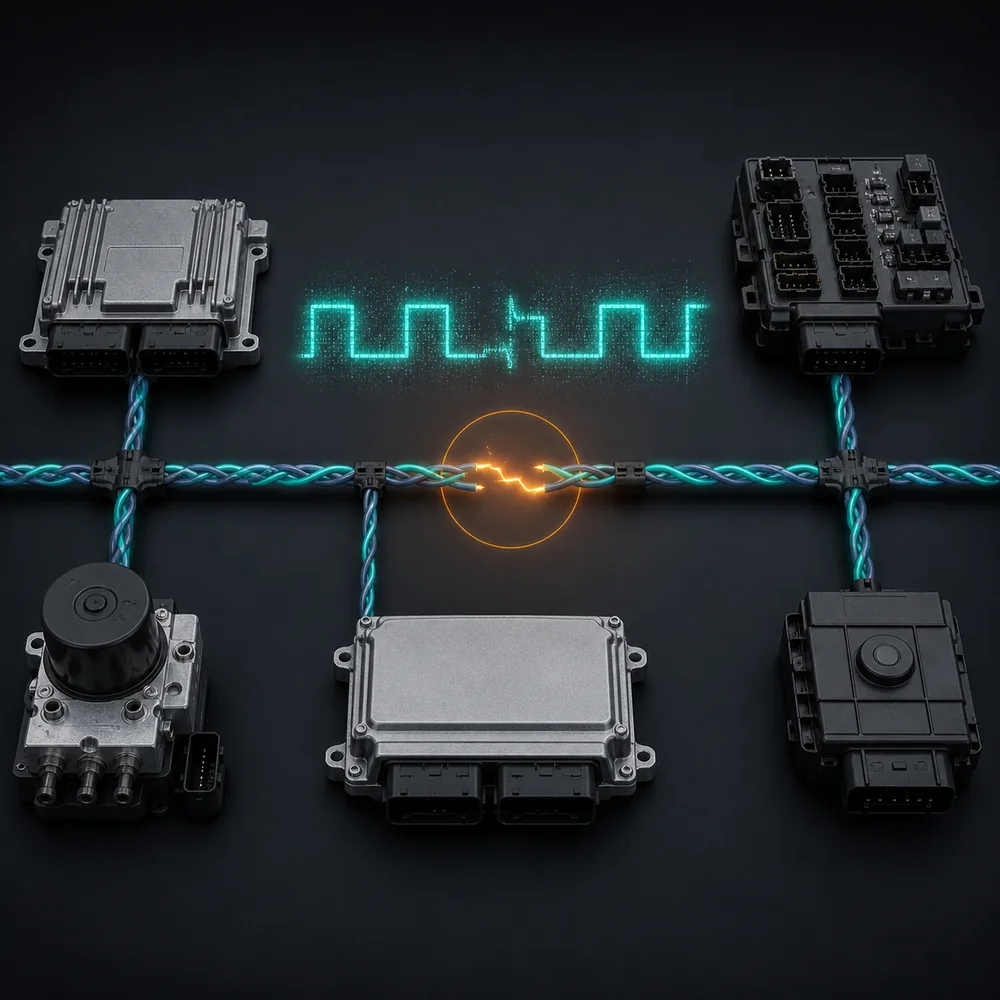
The high-speed CAN bus is a two-wire (CAN-High and CAN-Low) differential network operating at 500 kbps, used by powertrain, chassis, and some body control modules to exchange real-time data. When the ECM sets U0001, it has detected one of three primary failures: an open circuit in either bus wire, a short between the two wires, or a short to ground/voltage in one of the lines. The ECM monitors bus voltage levels (normally ~2.5V on both lines with no communication, ~3.5V on CAN-High and ~1.5V on CAN-Low during active communication) and flags U0001 if these parameters fall outside expected ranges for more than a brief period.
Physically, the CAN bus wiring is a twisted pair to reduce electromagnetic interference, with 120-ohm terminators at each end (typically at the ECM and another major module like the TCM or instrument cluster). If either terminator is missing or the wiring is damaged, signal reflection or noise can corrupt data, causing modules to drop off the bus. The ECM may also set U0001 if a module itself fails internally and stops communicating, but this is less common than wiring or terminator issues. In most cases, the malfunction is intermittent at first, often triggered by vibration, temperature changes, or electrical load fluctuations (e.g., during cold starts or when turning on high-draw accessories like headlights or the A/C).
Diagnosing U0001 requires checking the CAN bus voltage with a scan tool or oscilloscope, measuring resistance between CAN-High and CAN-Low (should be ~60 ohms with both terminators present), and inspecting the wiring harness for damage, corrosion, or poor connections at the OBD2 port or module connectors. A common oversight is assuming the issue is with a specific module when the root cause is often the wiring or a missing terminator. For example, a chafed CAN bus wire near the engine compartment or a corroded pin at the ECM connector can disrupt the entire network, even if individual modules are functional.
The severity of U0001 depends on which modules lose communication. If the ECM and TCM can no longer communicate, the vehicle may default to a limp mode or fail to shift properly. Loss of ABS or instrument cluster communication can disable traction control or leave the dashboard dark. In some vehicles, the entire CAN bus may go silent, causing multiple U-codes (e.g., U0100, U0121) alongside U0001, as other modules also detect the communication failure.
Common Symptoms of U0001
Symptoms vary widely but often include illumination of the check engine light, transmission shifting issues, or a completely dead instrument cluster. In mild cases, you may notice intermittent warning lights or erratic gauge behavior, especially during cold starts or when driving over rough roads. Severe cases can leave the vehicle undriveable, with no communication to critical systems.
Typical Causes of U0001
Most U0001 cases stem from wiring or connection issues, such as damaged CAN bus wires, corroded connectors, or missing terminators. Less commonly, a failed module or internal ECM/TCM fault may be the culprit. Repairs typically range from $150 to $1,000+ depending on the cause. See the full U0001 repair cost guide for a detailed breakdown.
Can You Still Drive With Code U0001?
Driving with U0001 is not recommended, as the vehicle may enter limp mode or lose critical functions like ABS or transmission control. If the instrument cluster or primary systems are non-functional, the car could become unsafe to operate. Towing is advisable if symptoms are severe.
Details that improve the diagnosis
Start with a complete network scan and identify which modules are present, absent or reporting invalid data. Verify battery voltage and the missing module power supplies before measuring the CAN bus. Use the correct topology and connector view to avoid disturbing a healthy network.
Before clearing anything, record whether the code is current, pending, history or permanent. Save companion codes and freeze-frame conditions, then note recent repairs, a weak battery, weather changes and the exact moment the symptom appears. After a confirmed repair, clear only the erasable codes and complete the appropriate drive cycle. A permanent code normally clears only after the onboard monitor verifies that the fault is gone.
Information to record before any repair
Write down the exact code, its status and every companion code reported by a complete vehicle scan. Save the freeze-frame values, including engine speed, load, coolant temperature, vehicle speed, battery voltage and fuel trims when available. Note whether the warning appeared during a cold start, at idle, under acceleration, after refueling, in wet weather or immediately after other work. These details help separate an intermittent electrical problem from a repeatable mechanical or operating-condition fault.
Identify the exact year, make, model, engine, transmission and market version before using a wiring diagram or specification. Connector pinouts, monitor thresholds, component locations and test procedures can change within the same model line. Check current manufacturer service information and relevant technical service bulletins. A bulletin can improve the test sequence, but it should not be treated as proof that the same fault exists on every vehicle.
How to verify the repair
A warning light that stays off immediately after codes are cleared does not by itself confirm a repair. Recheck live data, repeat the operating condition that originally set the code when it is safe to do so, and confirm that no pending code returns. Some monitors need a specific drive cycle before they run. Permanent codes are normally removed by the control module only after it sees enough successful monitor results. If symptoms remain or the code returns, continue testing instead of replacing another part by guesswork.