
P0131: Low Voltage in Bank 1 Sensor 1 O2 Sensor
P0131 O2 Sensor Low Voltage Fix (Bank 1 Sensor 1). See symptoms, common causes, driving risk and checks that help confirm the fault before parts are replaced.
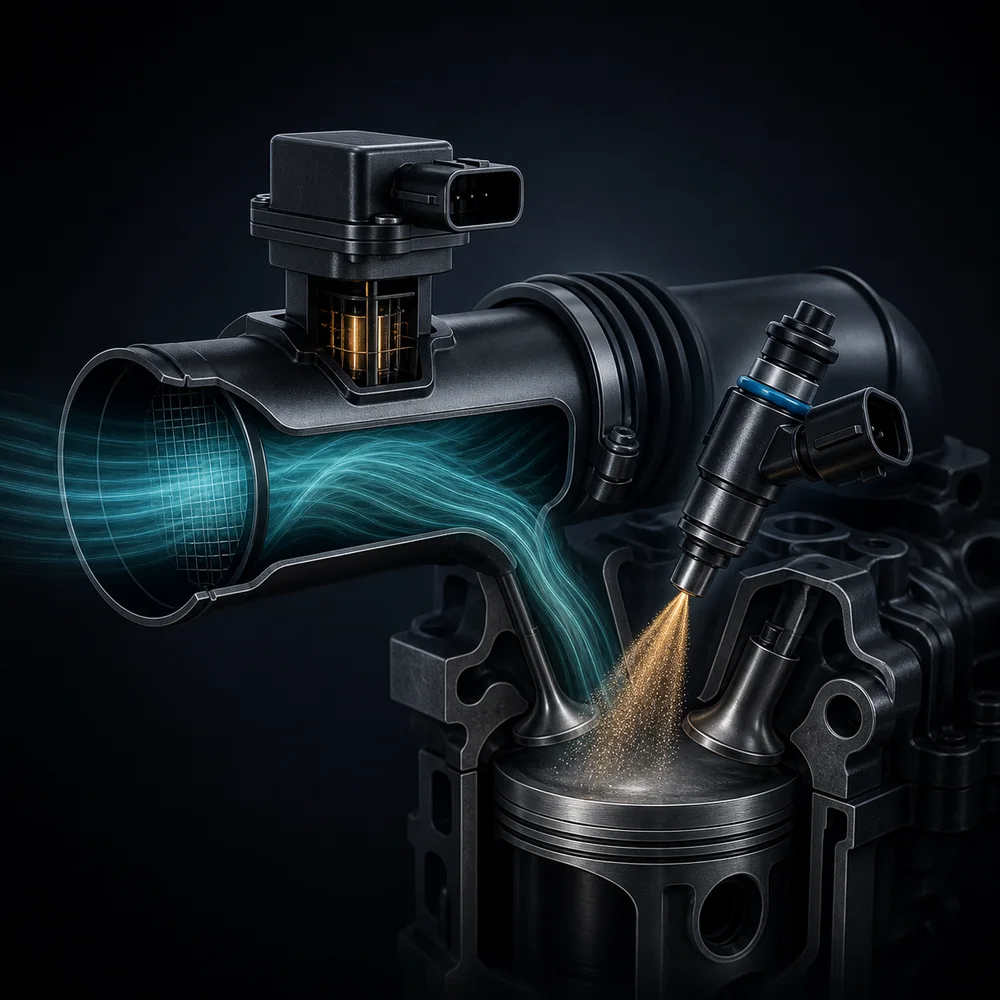
Save all codes and freeze-frame data. The code tells you what the control module detected, not which component must be replaced.
Quick answer
Code P0131 means the engine control module (ECM) detected a consistently low voltage signal from the upstream oxygen (O2) sensor on Bank 1, Sensor 1. This indicates the sensor is reading a lean exhaust condition for too long, often due to a faulty sensor, wiring issue, or an actual lean fuel mixture. In most cases, the sensor itself or its circuit is the primary suspect.
What P0131 Code: O2 Sensor Low Voltage (Bank 1 Sensor 1) Means
How the ECM Detects P0131
The upstream O2 sensor (Bank 1, Sensor 1) monitors oxygen levels in the exhaust before the catalytic converter. It generates a voltage signal that fluctuates between ~0.1V (lean) and ~0.9V (rich) under normal conditions. The ECM expects this signal to cycle rapidly as it fine-tunes the air-fuel ratio. When the sensor's voltage stays below ~0.2V for an extended period; typically 10-20 seconds under closed-loop operation; the ECM logs P0131, flagging a persistent lean condition or sensor malfunction.
The Role of Bank 1 Sensor 1
Bank 1 refers to the side of the engine containing cylinder #1, and Sensor 1 is the upstream (pre-cat) O2 sensor on that bank. This sensor is critical for fuel trim adjustments: its readings directly influence how much fuel the ECM injects. A low voltage signal can be caused by the sensor itself failing (e.g., internal contamination, heater circuit issues, or age-related degradation), but it can also result from external factors like vacuum leaks, low fuel pressure, or exhaust leaks near the sensor. The ECM cannot distinguish between a bad sensor and a real lean condition without further diagnostics.
Why Low Voltage Triggers the Code
O2 sensors produce low voltage in lean conditions because excess oxygen in the exhaust reduces the voltage output. If the sensor is exposed to atmospheric air (due to an exhaust leak) or the engine is genuinely running lean (e.g., from a vacuum leak or clogged fuel injectors), the voltage drops. However, if the sensor's internal circuitry degrades; such as a contaminated or lazy sensor; it may fail to generate higher voltages even when the exhaust is rich. The ECM interprets this as a persistent lean condition, setting P0131. In most cases, a healthy sensor should cycle voltage rapidly; a stuck-low reading points to a problem.
Common Misinterpretations
P0131 is often assumed to mean the O2 sensor is simply bad, but this isn't always true. While a faulty sensor is the most common cause, the code can also appear due to issues like a blown fuse in the sensor's heater circuit (causing slow response), wiring damage (shorted or open circuits), or even a rich condition on the opposite bank (if the ECM is cross-compensating). For example, a severe vacuum leak can force the ECM to enrichen the mixture excessively, which may indirectly cause the O2 sensor to read lean. Proper diagnosis requires checking sensor voltage live with a scan tool, not just replacing parts.
Symptoms of P0131
Drivers commonly notice poor fuel economy, rough idling, or a lack of power during acceleration, as the ECM struggles to maintain the correct air-fuel ratio. The check engine light will be illuminated, and in severe cases, the vehicle may hesitate or stall. These symptoms occur because the ECM relies on inaccurate sensor data to adjust fuel delivery.
How to Diagnose P0131
Diagnosis starts with inspecting the O2 sensor and its wiring for damage, contamination, or loose connections. Using a scan tool to monitor live sensor voltage can confirm if it's stuck low. If the sensor appears functional, further checks for vacuum leaks, fuel pressure, and exhaust leaks are necessary. A full diagnosis often requires professional equipment to rule out less obvious causes.
Can You Still Drive With Code P0131?
You can usually continue driving with P0131 in the short term, but it's not advisable for long. The vehicle may run poorly, reduce fuel efficiency, or cause long-term damage to the catalytic converter if the underlying issue forces a persistently lean or rich condition. Addressing the code promptly prevents more costly repairs.
Related Codes
P0131 is often accompanied by codes that help narrow down the issue. For example, P0130 (O2 Sensor Circuit Malfunction, Bank 1 Sensor 1) may appear if the sensor's signal is completely out of range, while P0171 (Fuel System Too Lean, Bank 1) can indicate the lean condition is engine-wide rather than sensor-specific. Additionally, P0135 (O2 Sensor Heater Circuit Malfunction, Bank 1 Sensor 1) may point to a heater circuit failure affecting sensor performance.
Details that improve the diagnosis
Compare the reported value with engine temperature, barometric pressure, throttle position and related sensors. A signal that is electrically valid can still be implausible. Fuel trims at idle and at a steady higher speed help separate an intake leak from a fuel-delivery or measurement problem.
Before clearing anything, record whether the code is current, pending, history or permanent. Save companion codes and freeze-frame conditions, then note recent repairs, a weak battery, weather changes and the exact moment the symptom appears. After a confirmed repair, clear only the erasable codes and complete the appropriate drive cycle. A permanent code normally clears only after the onboard monitor verifies that the fault is gone.