
P0105: MAP/Barometric Pressure Circuit Malfunction
P0105 Code: MAP Sensor Circuit Issues & Fixes. See symptoms, common causes, driving risk and checks that help confirm the fault before parts are replaced.
Save all codes and freeze-frame data. The code tells you what the control module detected, not which component must be replaced.
Quick answer
The P0105 code means the engine control module (ECM) has detected a malfunction in the Manifold Absolute Pressure (MAP) sensor or its circuit, specifically an issue with the signal being out of expected range. This code triggers when the ECM sees a voltage or pressure reading that is too low, too high, or erratic, indicating a problem with the MAP sensor's ability to measure intake manifold pressure accurately.
What Does the P0105 Code Mean for the MAP/Barometric Pressure Circuit?
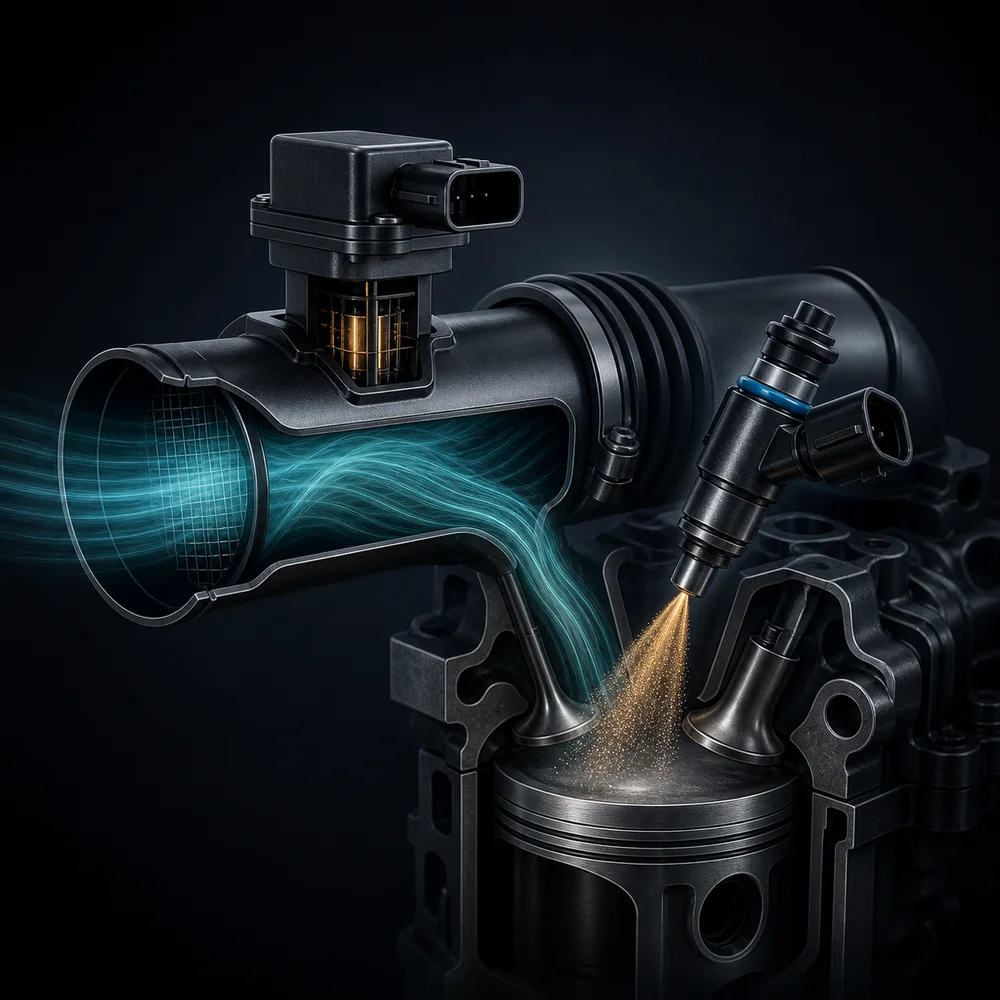
The MAP sensor measures the pressure inside the intake manifold, which helps the ECM calculate engine load and adjust fuel delivery and ignition timing accordingly. In some vehicles, the MAP sensor also doubles as a barometric pressure sensor when the engine is off, providing atmospheric pressure data for the ECM. The P0105 code is set when the ECM detects a circuit malfunction in this system, meaning the signal from the MAP sensor is either missing, too low, or too high compared to expected values under the current operating conditions.
The ECM expects the MAP sensor's voltage to fluctuate with engine load: higher manifold pressure (e.g., at idle or wide-open throttle) produces higher voltage, while lower pressure (e.g., at cruise or deceleration) produces lower voltage. When the signal falls outside the ECM's programmed parameters for a set duration, it logs P0105. This could be due to a faulty sensor, damaged wiring, a loose or corroded electrical connector, or even a vacuum leak skewing the pressure readings. In vehicles where the MAP sensor also reads barometric pressure, a failure in this secondary function can trigger the code as well.
Common scenarios that trigger P0105 include a MAP sensor that is disconnected, shorted, or internally failed, producing a flat or erratic signal. A broken or frayed wire in the sensor's 3-wire circuit (5V reference, ground, and signal) can also cause the voltage to drop or spike. Less commonly, a severe vacuum leak can cause the manifold pressure to read abnormally low, though this often triggers other codes (like P0106 or P0107) as well. The ECM uses this data to fine-tune air-fuel ratios, so an inaccurate MAP reading can lead to poor engine performance, hesitation, or even a no-start condition in extreme cases.
Diagnosing P0105 typically starts with a visual inspection of the MAP sensor and its wiring. Technicians check for loose connections, damaged wires, or corrosion at the sensor's electrical pins. If the wiring appears intact, a scan tool is used to monitor the MAP sensor's live data. A healthy sensor will show smooth, logical changes in pressure (in kPa or inches of Hg) as the engine RPM and load vary. If the reading is stuck at a single value, jumps erratically, or reads zero, the sensor itself is likely faulty. A multimeter can also be used to test the sensor's power and ground circuits, ensuring the sensor is receiving the correct 5V reference and a solid ground before replacing it.
Common Symptoms of P0105
Symptoms of a P0105 code often include rough idle, poor acceleration, and reduced fuel efficiency, as the ECM struggles to compensate for inaccurate pressure data. In some cases, the engine may hesitate or stumble when accelerating, particularly under load. A check engine light is the most consistent indicator, though drivability issues may not be noticeable in early stages of the fault.
How Is P0105 Diagnosed and Fixed?
Diagnosing P0105 involves checking the MAP sensor, its wiring, and connectors for damage or corrosion, followed by live data analysis to confirm the sensor's output. Fixes commonly include replacing the MAP sensor, repairing damaged wiring, or cleaning corroded connections. Repairs typically range from $150 to $1,000+ depending on the cause; see the full P0105 repair cost guide for a detailed breakdown.
Can You Still Drive With Code P0105?
Driving with a P0105 code is generally possible, but not recommended for long periods. In most cases, the vehicle will run, though you may notice reduced performance, poor fuel economy, or rough operation. If the issue causes severe drivability problems (e.g., stalling or no-start), the vehicle should be serviced immediately to avoid potential damage.
Details that improve the diagnosis
Compare the reported value with engine temperature, barometric pressure, throttle position and related sensors. A signal that is electrically valid can still be implausible. Fuel trims at idle and at a steady higher speed help separate an intake leak from a fuel-delivery or measurement problem.
Before clearing anything, record whether the code is current, pending, history or permanent. Save companion codes and freeze-frame conditions, then note recent repairs, a weak battery, weather changes and the exact moment the symptom appears. After a confirmed repair, clear only the erasable codes and complete the appropriate drive cycle. A permanent code normally clears only after the onboard monitor verifies that the fault is gone.
Information to record before any repair
Write down the exact code, its status and every companion code reported by a complete vehicle scan. Save the freeze-frame values, including engine speed, load, coolant temperature, vehicle speed, battery voltage and fuel trims when available. Note whether the warning appeared during a cold start, at idle, under acceleration, after refueling, in wet weather or immediately after other work. These details help separate an intermittent electrical problem from a repeatable mechanical or operating-condition fault.
Identify the exact year, make, model, engine, transmission and market version before using a wiring diagram or specification. Connector pinouts, monitor thresholds, component locations and test procedures can change within the same model line. Check current manufacturer service information and relevant technical service bulletins. A bulletin can improve the test sequence, but it should not be treated as proof that the same fault exists on every vehicle.
How to verify the repair
A warning light that stays off immediately after codes are cleared does not by itself confirm a repair. Recheck live data, repeat the operating condition that originally set the code when it is safe to do so, and confirm that no pending code returns. Some monitors need a specific drive cycle before they run. Permanent codes are normally removed by the control module only after it sees enough successful monitor results. If symptoms remain or the code returns, continue testing instead of replacing another part by guesswork.