
P0102: MAF Circuit Low Input Explained
P0102 Code: MAF Sensor Low Input Causes & Fixes. See symptoms, common causes, driving risk and checks that help confirm the fault before parts are replaced.
Save all codes and freeze-frame data. The code tells you what the control module detected, not which component must be replaced.
Quick answer
OBD2 code P0102 means the engine control module (ECM) has detected an unusually low voltage signal from the mass airflow (MAF) sensor circuit. This indicates the sensor is either unplugged, damaged, or reading an abnormally low airflow value, which the ECM interprets as a circuit malfunction rather than a genuine airflow issue.
What the P0102 Code Means: MAF Circuit Low Input Explained
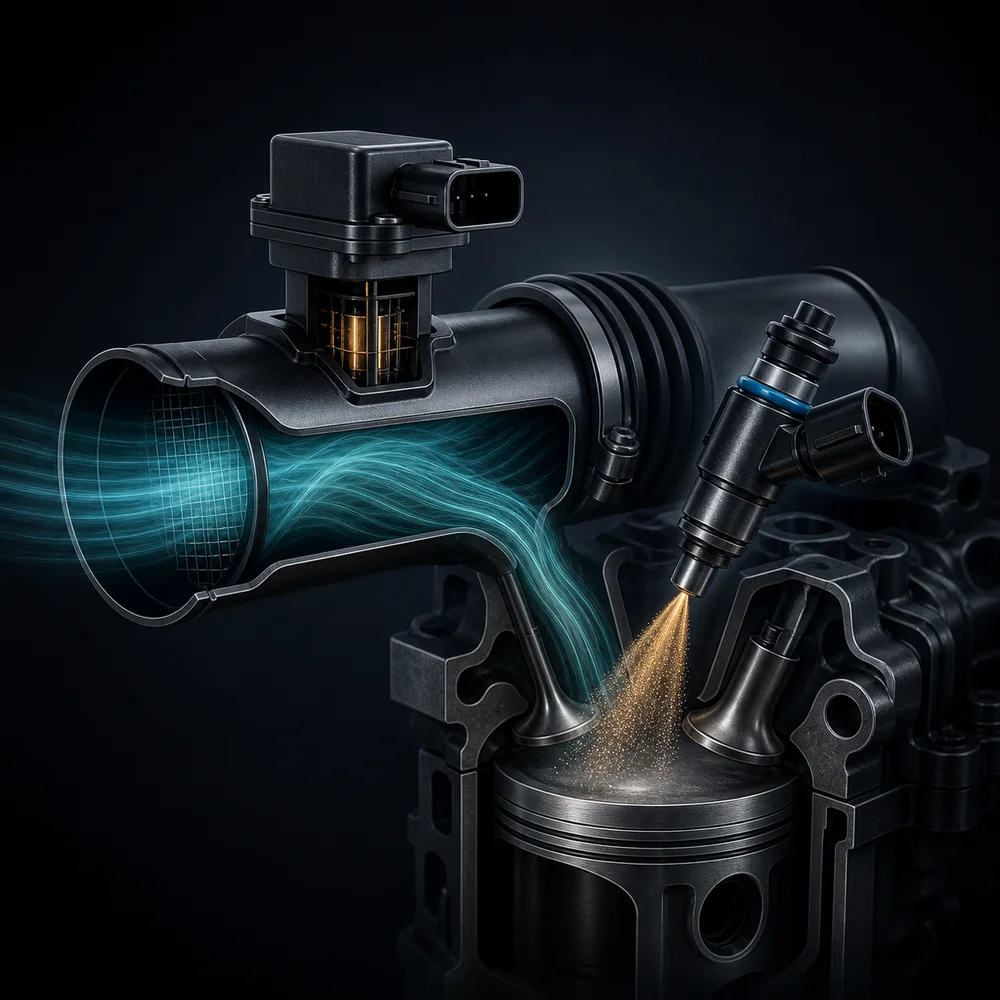
The MAF sensor measures the volume and density of air entering the engine, providing critical data for the ECM to calculate the correct fuel mixture. When the ECM sets a P0102 code, it has detected that the MAF sensor's 5-volt reference circuit is outputting a signal below the expected minimum threshold; typically under 0.2 volts on most vehicles. This low-voltage condition can occur for several technical reasons, all of which point to an electrical or sensor integrity issue rather than a true airflow deficiency.
In a properly functioning system, the MAF sensor's hot wire is heated to a constant temperature, and incoming air cools it down. The ECM supplies a current to maintain that temperature, and the amount of current required directly correlates to airflow. A P0102 code triggers when the ECM sees that the current required is abnormally low, which usually means the sensor isn't detecting enough airflow to cool the wire, or the circuit itself is compromised. Common scenarios include a disconnected or damaged wiring harness, a faulty MAF sensor, or a short to ground in the signal wire. In some cases, a clogged air filter can restrict airflow enough to cause a false low-input reading, though this is less common than electrical issues.
It's important to note that the ECM distinguishes between a low *input* (P0102) and a low *airflow* condition (which might set a different code or none at all). A P0102 specifically flags a circuit or sensor problem, not necessarily an airflow restriction. For example, if the MAF sensor is unplugged, the ECM will see 0 volts on the signal wire and immediately set P0102. Similarly, if the signal wire is shorted to ground, the voltage will drop below the expected range, triggering the same code. The ECM relies on this input to adjust fuel delivery, so a faulty reading can lead to drivability issues like poor acceleration or rough idling.
Diagnosing P0102 requires checking the MAF sensor's wiring and connector for damage, corrosion, or loose connections. A multimeter can be used to verify the sensor's 5-volt reference voltage, ground, and signal output. If the wiring and connector are intact, the MAF sensor itself may need to be tested or replaced. In rare cases, a contaminated MAF sensor (e.g., due to oil from an aftermarket air filter) can cause erratic readings, though this more commonly triggers a P0101 (MAF Circuit Range/Performance) code. Cleaning the sensor with a specialized MAF cleaner can sometimes restore function, but if the circuit is damaged, replacement is the only solution.
Most vehicles use a 5-wire MAF sensor: 12V power, ground, 5V reference, signal output, and sometimes an intake air temperature (IAT) signal. A break or short in any of these circuits can cause P0102, but the signal wire and reference voltage are the most critical to inspect. If the ECM detects a consistent low voltage on the signal wire, it assumes the sensor isn't working and defaults to a predetermined fuel map, which can result in reduced performance and fuel economy.
Symptoms of P0102
Drivers often notice a lack of power, hesitant acceleration, or rough idling when P0102 is present, as the ECM struggles to maintain the correct air-fuel ratio. In some cases, the check engine light may be the only visible symptom if the issue is intermittent. See the full P0102 symptoms guide for a detailed breakdown of how this code affects drivability.
Common Causes of P0102
P0102 is most frequently caused by a disconnected or damaged MAF sensor, a short or open in the wiring harness, or a faulty MAF sensor itself. Other potential triggers include a blown fuse in the sensor's circuit or corrosion in the connector pins. Repairs typically range from $150 to $400 depending on the cause, see the full P0102 repair cost guide for a detailed breakdown.
Can You Still Drive With Code P0102?
You can usually drive short distances with P0102, but prolonged driving may lead to reduced fuel economy, poor performance, or potential damage to the catalytic converter due to an incorrect air-fuel mixture. If the vehicle runs rough or hesitates severely, it's best to address the issue immediately to avoid further complications.
Details that improve the diagnosis
Compare the reported value with engine temperature, barometric pressure, throttle position and related sensors. A signal that is electrically valid can still be implausible. Fuel trims at idle and at a steady higher speed help separate an intake leak from a fuel-delivery or measurement problem.
Before clearing anything, record whether the code is current, pending, history or permanent. Save companion codes and freeze-frame conditions, then note recent repairs, a weak battery, weather changes and the exact moment the symptom appears. After a confirmed repair, clear only the erasable codes and complete the appropriate drive cycle. A permanent code normally clears only after the onboard monitor verifies that the fault is gone.